
- Updated April 10, 2026
- 10-minute read
- Reviewed by Affordable Diabetic Direct Editorial Team
⚡ Quick Answer
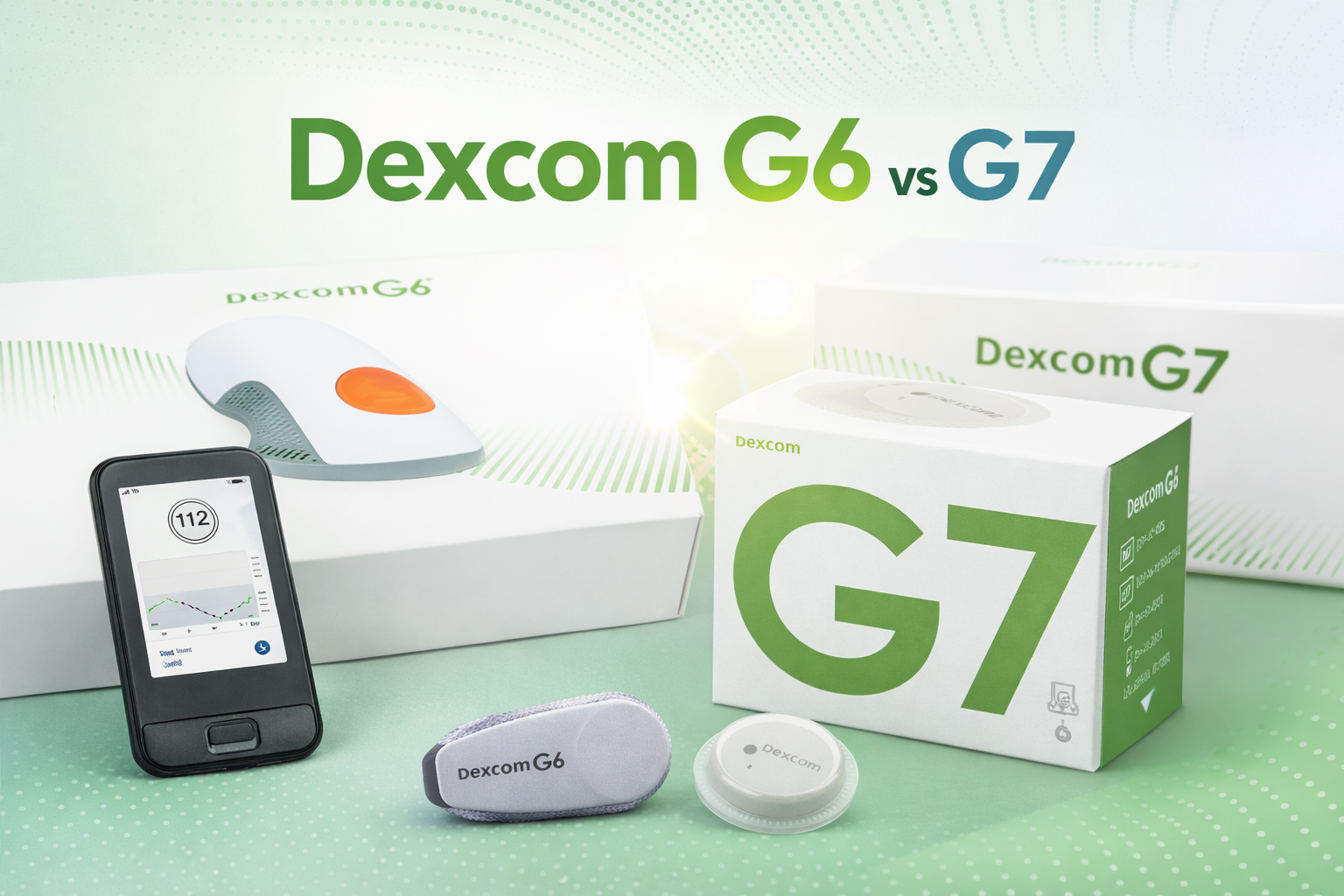
The Dexcom G7 is smaller, faster, and more accurate than the G6, making it the best choice for most users in 2026. However, the Dexcom G6 remains a more affordable option with wider insurance coverage. You can buy both models online from Affordable Diabetic Direct with fast shipping and competitive pricing.
Why Dexcom CGMs Matter
Dexcom CGMs have revolutionized how people with diabetes monitor blood glucose. Instead of fingersticks, the sensors continuously track glucose levels every five minutes, sending real-time data to your phone or receiver. These systems help:- Prevent hypoglycemia and hyperglycemia.
- Improve HbA1c levels.
- Provide alerts for glucose spikes or drops.
- Support advanced insulin management with connected pumps.
Dexcom G6 vs G7: A Quick Comparison Table
Here’s a snapshot comparison before we go deeper:| Feature | Dexcom G6 | Dexcom G7 |
| Sensor Wear Time | 10 days | 10 days |
| Warm-Up Time | 2 hours | 30 minutes |
| Transmitter | Separate reusable piece | Built-in (disposable) |
| App Compatibility | Dexcom G6 app, Tandem t:slim X2, Omnipod 5 | Dexcom G7 app, newer pump integrations |
| Accuracy (MARD) | ~9% | ~8.2% |
| Size | Larger, dual-piece | 60% smaller, all-in-one |
| Data Sharing | Dexcom Share & Follow apps | Built-in share features |
| FDA Approval | 2018 | 2022 |
| Insurance Coverage | Widely covered | Expanding coverage |
| Average Monthly Cost (without insurance) | $300–$350 | $350–$400 |
| Setup Time | 10–15 minutes | 5–10 minutes |
Where Can You Buy Dexcom G6 and G7 in 2026?
You can purchase Dexcom G6 and G7 sensors online through Affordable Diabetic Direct, offering competitive pricing, fast U.S. shipping, and reliable availability without long pharmacy delays.- Simple online checkout process
- Competitive pricing compared to retail pharmacies
- Fast and secure U.S. delivery
- Consistent stock for popular CGM models
What’s New in the Dexcom G7?
The Dexcom G7 represents Dexcom’s biggest hardware leap since the G6 launch in 2018. It’s designed to eliminate pain points users had with older models, such as transmitter reuse, long warm-up times, and bulkier wear.1. Smaller, Sleeker Design
The G7 sensor is about 60% smaller than the G6. The transmitter and sensor are now combined into a single disposable unit — so no more removing and reattaching a transmitter every 10 days. Why it matters: Fewer components mean fewer mistakes, faster setup, and a more comfortable fit on the skin — especially for those with active lifestyles or sensitive skin.2. Drastically Reduced Warm-Up Time
One of the most user-loved upgrades is the 30-minute warm-up versus the G6’s 2-hour period. That means if you replace your sensor in the morning, you can start receiving glucose readings before breakfast — instead of waiting until lunch.3. Improved Accuracy (MARD)
The G7 boasts a Mean Absolute Relative Difference (MARD) of 8.2%, compared to 9.0% for the G6. Lower MARD = higher accuracy. This improvement brings Dexcom’s sensors among the most precise CGMs globally — placing it among the most accurate CGMs available today.4. Simplified App Integration
The new Dexcom G7 provides cleaner visuals and simplified calibration reminders. It also allows for:- Seamless data sharing with healthcare providers.
- Direct integration with Apple Health and Android systems.
- Remote monitoring through Dexcom Follow for parents and caregivers.
What the Dexcom G6 Still Does Well
Despite being older, the Dexcom G6 continues to be one of the most widely used CGMs in the U.S. in 2026 — mainly due to its affordability and compatibility. Here’s why many users still prefer it:1. Strong Insurance Coverage
Because it’s been on the market longer, nearly all major insurers, including Medicare and private plans, fully or partially cover the G6. Some users can get supplies for as low as $20–$50 per month with the right prescription plan.2. Compatibility with Popular Devices
The G6 integrates seamlessly with:- Tandem t:slim X2 insulin pump
- Omnipod 5 system
- Apple Watch and Fitbit (via smartphone apps)
3. Separate Transmitter = Lower Waste
While the G7’s all-in-one design is convenient, it’s also fully disposable, creating more waste and higher costs per cycle. The G6’s reusable transmitter lasts about three months, reducing long-term cost and environmental footprint. Pro Tip: If you’re cost-conscious or already invested in the G6 ecosystem, it’s perfectly fine to stay with the G6 in 2026 — it remains clinically reliable and FDA-cleared.Setup & Ease of Use: G7 Takes the Win
Setting up a CGM can feel intimidating for new users. Dexcom has simplified this dramatically with the G7.Dexcom G6 Setup:
- Requires attaching the sensor patch and inserting the wire manually.
- Snap on a reusable transmitter.
- Sync manually with the app.
- Wait 2 hours before first readings.
Dexcom G7 Setup:
- Peel, place, and press — all in one motion.
- Built-in transmitter, no assembly.
- Syncs automatically via Bluetooth.
- Ready in 30 minutes.
Accuracy and Performance: How Do They Compare?
Dexcom G6 vs G7 accuracy is often the deciding factor for advanced users.| Metric | G6 | G7 |
| MARD (Overall) | 9.0% | 8.2% |
| Calibration Needed | Optional | None required |
| Signal Reliability | Excellent | Improved Bluetooth connectivity |
| Data Frequency | Every 5 minutes | Every 5 minutes |
Cost & Affordability in 2026
Cost plays a major role in CGM selection, especially for those paying out-of-pocket or managing high deductibles.| Expense Category | Dexcom G6 | Dexcom G7 |
| Retail Sensor Kit (1 month) | $300–$350 | $350–$400 |
| Transmitter (every 3 months) | $200 | Not needed |
| Receiver (optional) | $250 | $250 |
| Total Annual Cost (est.) | ~$2,200 | ~$2,600 |
| With Insurance | $20–$75/month | $25–$100/month |
Insurance Coverage and Eligibility
Most insurance providers — including Medicare, UnitedHealthcare, Cigna, and Blue Cross Blue Shield — now cover Dexcom sensors, but the G7 coverage is still expanding. If your plan currently covers the G6:- Ask your doctor to update your prescription for the G7 if desired.
- Provide medical documentation for CGM necessity (most plans require proof of insulin use).
- Verify if your Durable Medical Equipment (DME) provider supports G7 distribution.
Compatibility: Devices and App Ecosystem
Dexcom G6 Compatibility
- iPhone 6S and newer
- Most Android 9.0+ phones
- Tandem t:slim X2
- Omnipod 5
- Apple Watch (via phone relay)
Dexcom G7 Compatibility
- iPhone 8 and newer
- Select Android models
- Future integrations with Tandem and Omnipod (under FDA rollout)
- Direct Apple Watch integration (coming in late 2026 update)
Comfort and Wearability
Both sensors are water-resistant and designed for 24/7 wear, but their form factors differ significantly.Dexcom G6
- Patch area: ~4 cm diameter.
- Slightly thicker profile.
- Reusable transmitter adds weight.
Dexcom G7
- Patch area: ~2.5 cm diameter.
- Lighter and flatter design.
- Integrated adhesive reduces peeling.
Which Dexcom Is Best for You?
| User Type | Recommended CGM | Why |
| Budget-conscious / insured users | Dexcom G6 | Cheaper, more insurance coverage |
| Tech-savvy / early adopters | Dexcom G7 | Smarter, faster, and smaller |
| New CGM users | Dexcom G7 | Simplified setup and better accuracy |
| Long-time G6 users | Stay with G6 until coverage expands | Familiar workflow, reusable transmitter |
| Active / athletic users | Dexcom G7 | More durable adhesive and compact design |
Sustainability & Waste Reduction
A subtle but growing factor in 2026 is sustainability. Since the G7 is fully disposable, it creates slightly more medical waste per use than the G6. G6 Advantage:- Reusable transmitter = less plastic waste.
- Dexcom introduced recyclable outer packaging and eco-friendly adhesive materials.
FAQs: Dexcom G6 vs G7
How can I tell if an online supplier is legitimate?
Yes. The G7 has a slightly lower MARD of 8.2% versus the G6’s 9.0%, meaning improved accuracy and stability across glucose ranges.
Does the Dexcom G7 require calibration?
No calibration is needed. The G7 is fully factory-calibrated, while the G6 allows optional fingerstick verification.
How long do the sensors last?
Both sensors last 10 days per application, with automatic expiration alerts via the Dexcom app.
Can I still buy Dexcom G6 supplies in 2026?
Yes. The G6 remains widely available through pharmacies, suppliers, and online retailers like Affordable Diabetic Direct. Dexcom will continue supporting it through at least 2027.
Is the Dexcom G7 covered by insurance?
Yes — but coverage varies. Most major insurers are rolling out G7 approvals through 2026. Always confirm with your plan before switching.
Final Thoughts: Dexcom G7 Leads, but G6 Still Delivers
Ready to upgrade your CGM or restock your supplies?
Shop Dexcom G6 and Dexcom G7 sensors at Affordable Diabetic Direct for competitive prices, fast U.S. shipping, and reliable availability.
Skip pharmacy delays, avoid insurance hassle, and get the supplies you need delivered directly to your door — order today and stay in control of your glucose management.